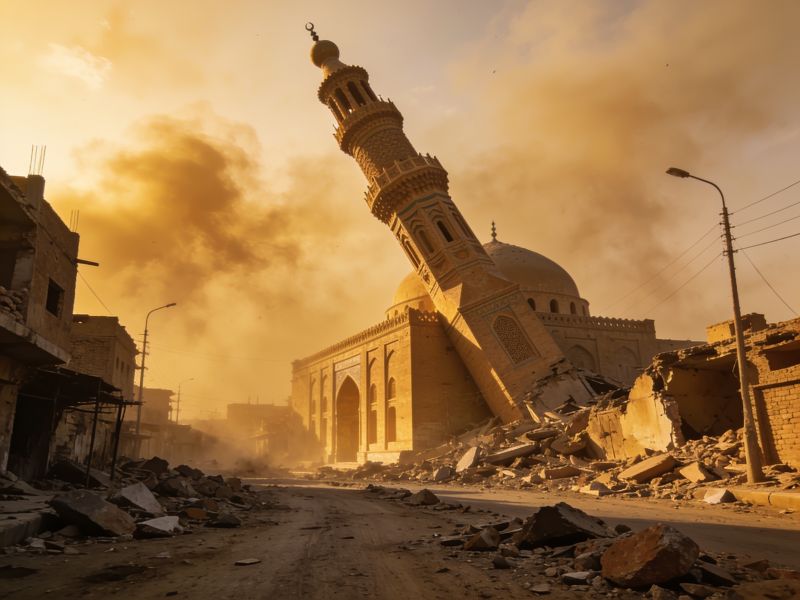
he clock tower of Mosul's Al-Nuri Mosque still leans at a precarious angle, its tilted silhouette a daily reminder of June 2017 when ISIS rigged the structure with explosives and blew it apart. Walking through the Old City's narrow alleys today, you step over piles of rubble that haven't moved in years. Concrete slabs dangle from what were once apartment ceilings. The smell of dust never really leaves. This is Mosul eight years after the declared end of the caliphate—a place where reconstruction is measured not in ribbon-cutting ceremonies but in the slow, stubborn return of a single family to a single house.Reconstruction has been uneven, to put it mildly. The World Bank estimated in 2018 that rebuilding Mosul's basic infrastructure would cost over $2 billion. Some neighborhoods on the eastern bank have regained electricity, water, and functioning schools. Cross the Tigris to the western side, though, and the picture darkens. Entire blocks of the Old City remain uninhabitable. Families who fled in 2016 and 2017 still live in displacement camps or crowded in with relatives. A shopkeeper I spoke with on Al-Jumhuriya Street—he reopened his fabric store in 2019—told me that customers are fewer。but at least the street has life again. That kind of granular recovery rarely makes headlines, yet it defines daily existence in Mosul more than any grand strategy document.What strikes you about Mosul is the gap between international attention and local reality. When ISIS controlled the city, Mosul was front-page news every day. Now, funding for stabilization projects has slowed. USAID and other donors have scaled back programs. Local NGOs fill some gaps, but they operate on shoestring budgets. The university。once a beacon for northern Iraq, has reopened its doors, but faculty retention is a chronic problem—many professors left for Erbil or abroad and haven't returned. Young people I met in the riverside cafes express a mix of exhaustion and defiance. They don't want sympathy. They want jobs, reliable electricity, and a reason to believe the next decade won't bring another catastrophe.Sectarian and ethnic tensions haven't vanished, but they've shifted. Mosul was always a mosaic—Arabs, Kurds, Assyrians, Turkmen, Shabak, Yazidis in the surrounding Ninewa plains. ISIS exploited those fault lines;
the post-ISIS period has seen cautious, sometimes awkward coexistence. Churches in the old city have been partially restored。and a handful of Christian families have returned to the Alqosh and Tel Keppe areas nearby. Muslim and Christian neighbors trade goods in the same markets. Is it fragile?
Absolutely. But it's also more functional than outside observers often assume. The real threat now isn't ideology—it's economic stagnation and political inertia in Baghdad, where Mosul's reconstruction competes with a long list of national crises for attention and money.Mosul doesn't need another keynote speech about resilience. It needs cranes, cement, and consistent electricity. It needs its diaspora to feel safe enough to invest. It needs a local government that can approve a building permit without a bribe. The city's fate matters far beyond Iraq—it's a test case for whether post-conflict urban recovery can actually work when the cameras leave. From what I've seen, the people of Mosul are doing their part. The rest of us should stop treating their city as a cautionary tale and start treating it as a place worth rebuilding.